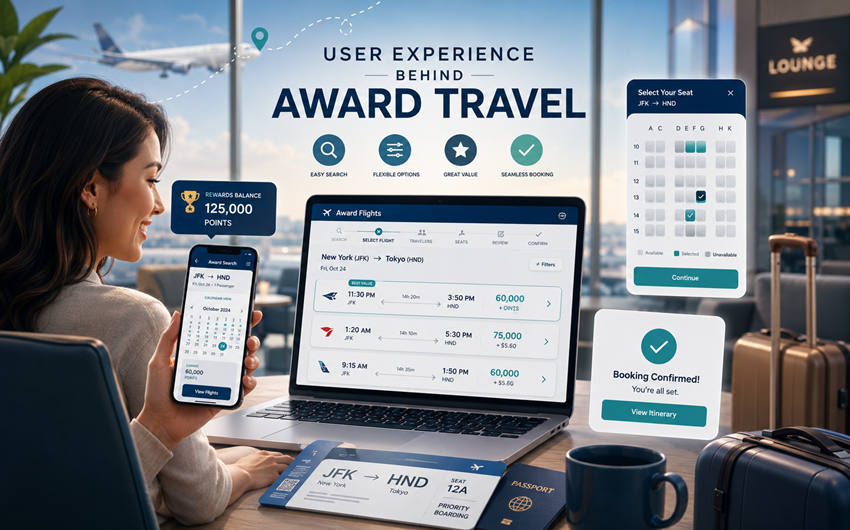
The User Experience Behind Award Travel: Why Simplicity Matters

The concept of business class, luxury accommodations, and global travel through the strategic use of points and miles is quite attractive to an increasing number of consumers. Simultaneously, award travel remains a misunderstood and daunting area for many. Complicated structures of airline loyalty, variable and often cryptic rules for redemption, and a lack of award travel resources combine and contribute to the underutilization of travel points.
Contrary to popular belief, there is interest in the area. In fact, millions of consumers spend time and resources collecting points from credit cards, airlines, and hotels each year. The issue is with the barriers to the travel systems. While the travel systems and credit cards have improved their user experience and made the collection of travel points easier, the systems for booking award travel have become more complicated.
It has become common knowledge that one of the most important factors for the success of any digital product is the user experience. Award travel is no different. The user experience with a travel booking system is one of the key differentiators in a competitive marketplace.
This area of travel points provides insight into user experience and the reason behind the disparity of success and failure of travelers when attempting to book award travel.
The Problems with Complexity for Award Travel Users
The design of award travel systems has not historically prioritized user experience. Instead, the focus has been on the internal systems of the flight and hotel travel business. For instance, the development of frequent flyer programs has incorporated new rules and new ways to collaborate and price and redeem programs, but has largely ignored the development of the overall system from the user’s perspective.
The opacity of these systems means that award travelers have to construct their own solutions that include, at minimum, an understanding of how to compare different airline alliances and their transfer partners, the constantly changing award prices and a way to work through the mechanical system of award travel.
Once you have experience doing this, managing these systems becomes relatively easy. For individuals without experience, this is actually dysfunctional and extremely overwhelming.
For award travel users who want to redeem points for a family vacation, they must now research the partnerships and prize selection of arbitrary airlines, redeeming and calculating the approximate values of fuel surcharges and transfer rules. This creates a very cumbersome research project for users who simply want to redeem points and makes a fun experience tedious and unnecessarily complex.
Why the User Experience is Key
Customers, more now than ever, value the ease and convenience that come with modern technology. Almost everything a consumer does offers them both the ability to make purchases and book services with the click of a button.
Travel award systems are unique in that, like most systems, the award travel systems require a more complex foundation. This means that the systems have to strike a balance between the complexity of the system and how much complexity is hidden from the user.
Good experience design allows users to concern themselves with the end goal, rather than the intricacies or mechanics of how to achieve the goal, which is how it should be with travel design.
When users are confident in the progress to complete a travel booking and feel that the system is lending them support, they are far more likely to use the system more actively and engage with loyalty programs to accumulate more rewards.
The Award Travel User Journey
The excitement to book an award flight is often the end of the traveler’s journey and the beginning of yours. Rewards are earned through a myriad of ways and it is only a matter of time before they are actually redeemed.
Unfortunately, this is where the confusion often starts.
Some users aren’t aware of which loyalty program is the best and others can’t figure out which offers the best value and why there’s so much variation in the price of a seat. Many users are made anxious by the fact that points can only be transferred one way between programs.
Friction can be found at any point in the process.
Experience design practitioners classify these instances as pain points, and award travel pain points in the form of perplexing prices, limited system transparency, inconsistent results, and jargon.
Eliminating any of these barriers can help achieve the dual goal of improving customer satisfaction and enhancing redemption success.
The Value of Transparency
One of the best, if not the greatest, design principles is transparency. System users want to know how the system works, and more importantly, what will bring about which result. Their frustration is almost guaranteed if there is an abrupt, unexplained change in pricing or a sudden lack of availability.
Travel award programs that clearly explain the process of how points can be redeemed, transferred, what fees will be incurred, and the whole booking process will be more trusted.
Travelers can set accurate expectations with the help of transparent communications with the travel service provider.
Travel planning requires a lot of trust between the customer and travel service provider because of the considerable investment of money and time that is involved.
If travel customers feel like they have the information needed to make a choice, they are more likely to stay engaged, even if the decision is a complicated one.
Too Much Information
One of the most commonly made mistakes in product design that is digital in nature is giving customers too much information too quickly in the process.
Travel award points can naturally create a lot of data that needs to be evaluated, including travel routes, airlines, point balances, transfers, taxes and fees, and calendars.
If a customer is shown all this data at the same time, it will create cognitive overload and they will abandon the process.
The best product design helps customers make a choice by showing data in an incremental manner. This product design also shows customers data when they need it at a point in their travel process.
The best product design makes the process feel like it requires less effort, while also allowing customers to feel more confident that they made the best choice.
Great platforms walk customers through each step of award travel rather than expecting customers to become experts.
User Experience Teaching
In order to travel using award points, some learning and teaching must take place. Even though a lot of customers don’t know the fundamental rules and structure of reward points travel, they are willing to learn. The most successful educational content for award travel design is the content that gives the customer the information for the simplest example first and is the least abstract.
For instance, travelers needing guidance on how to redeem travel points can use a comprehensive guide that details travel points redemption from A to Z. User experience is drastically improved with resources that break down airline alliances, demystify points transfers and explain points redemption in a straightforward manner.
To simplify a complex process, many people choose to start their travel experience by learning through resources such as a straightforward award flight booking guide.
When the user experience incorporates education instead of treating education as an appendage, the user engages more successfully and confidently.
The role of advanced technology in award travel
Over the past decade, the rapid advancement of technology has changed the award travel landscape.
Search engines, automated notifications, advanced algorithms, and integrated travel bookings have all but eliminated the myriad of time-intensive manual tasks that plagued award travel.
Artificial Intelligence and Machine Learning are only beginning to have their impact felt. These technologies can examine enormous amounts of award travel data, pinpoint crucial award travel opportunities for users, and tailor suggestions based on specific user needs and preferences.
Travelers no longer need to visit multiple sites and compare dozens of award travel options manually.
Smart search technology that allows users to make informed award travel choices with minimal effort is what the travel technology industry strives for.
Travel reward technology will continue to advance rapidly, and one of the primary catalysts will be notable shifts in user experience.
Why Simplicity Increases Engagement
Simplicity is often equated with feature reductions or diminished functionality. In fact, simplicity is about strong systems that feel accessible.
Having an intuitive interface does not mean that a system is incapable of supporting advanced functions.
Feeling intimidated leads users to disengage, while feelings of empowerment promote exploration and utilization. This is especially true with award travel.
People that are able to redeem points for award travel for the first time often become very loyal to travel reward programs. The more positive travel experiences people have, the more they travel and engage with the companies from which they are trying to earn travel points and miles.
A great first experience is often the single most important factor in making people lifelong point and mile enthusiasts versus making them never want to travel award style ever again.
Designing for Both Beginners and Experts
One of the most difficult things in designing travel award programs is addressing people with differing levels of expertise.
Less experienced award travelers often need more guidance while more experienced award travelers often want the exact opposite and want much more flexibility as well as a lot more control and detailed options. Successful travel award systems are able to balance these disparate needs.
Less experienced award travelers are able to utilize more guided and streamlined award travel design systems while experienced travelers can jump straight to advanced and specialized travel award design interfaces.
With many different types of travelers having many different levels of expertise, travel award systems should be designed to grow with travelers.
Users could one day receive recommendations tailored to their travel goals, preferred destinations, and points history. Meaning real-time alerts might even recognize the best opportunities to redeem points. Smart assistants may also help travelers decide and book with optimal efficiency.
The more interconnected loyalty systems become, the less difference there may be between describing the earning and the redeeming of points.
The balance of systems will tip toward the value they provide to the user, rather than the value they provide to the system.
Travelers will no longer need to spend their time and mental energy learning the inner workings of loyalty systems. The focus of future systems will be to deliver the correct outcome in the most efficient and least obstructive manner.
The most straightforward end goal will be to help users travel the world with the points they have already earned.
Conclusion
Traveling for reward points is enticing due to all the benefits, but the systems can be overwhelming. Even with newer loyalty programs, travelers continue to experience confusing and inconsistent points redemption processes, and are met with far too much information.
If, and only if, the travel reward systems value simplification, transparency, and education, the overall user travel award experience will be drastically improved.
There is a need to adapt to provide more seamless digital offerings. Those programs that value user experience over all else will see the most reward.
Ultimately, the value of miles and points is not determined by the number of travelers who earn them; instead it is determined by the extent to which they can be redeemed by travelers to build experiences. Building simplicity and flexibility in the system, award travel can become more accessible, pleasurable, and beneficial to all travelers, regardless of experience level.