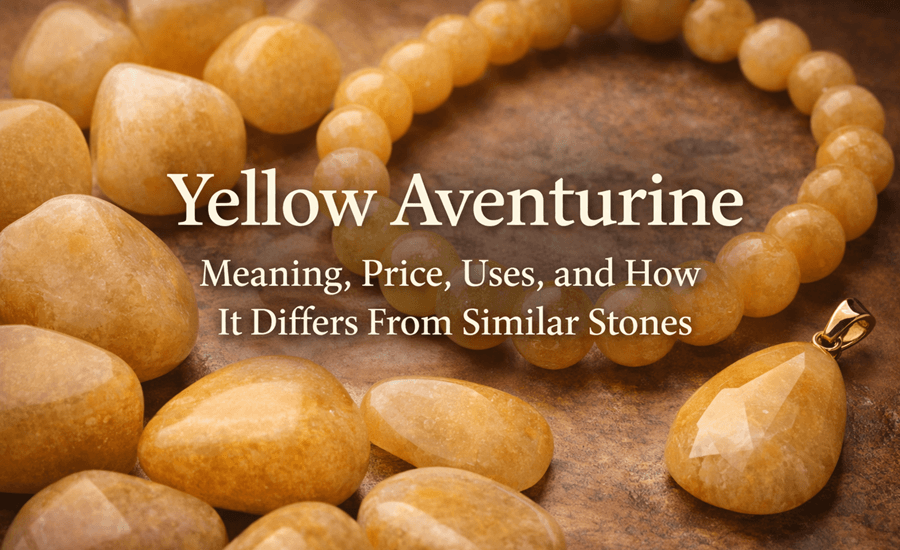
Yellow Aventurine Meaning, Price, Uses, and How It Differs From Similar Stones

Yellow aventurine is one of those gemstones that often catches attention slowly rather than loudly. It does not have the glassy transparency of citrine or the deep, lush color people usually expect from green aventurine. Instead, it has a softer beauty: warm yellow tones, a gentle shimmer, and an earthy presence that feels both cheerful and grounded. Because of that, it appeals to two very different groups at once. Some people love it simply as an affordable and wearable yellow stone. Others are drawn to it for its crystal meanings, especially its association with confidence, optimism, and personal strength.
If you want a complete understanding of yellow aventurine, it helps to look at it from both sides: the gemological side and the symbolic side. That means asking what it is made of, where it comes from, how much it usually costs, what kind of jewelry it suits best, and how it differs from stones that are often confused with it, especially citrine and green aventurine. Once those pieces are clear, yellow aventurine becomes much easier to understand and much easier to buy well.
What yellow aventurine is
Yellow aventurine is a quartz-based gemstone in the aventurine family. Aventurine is known for its characteristic sparkle, called aventurescence, which comes from tiny reflective mineral inclusions inside the stone. In commercial jewelry language, you will also see it called “aventurine quartz.”
With yellow aventurine specifically, the exact description can vary a little depending on the specimen and the source you consult. Some references attribute its yellow color mainly to mica or muscovite inclusions, while others point to pyrite, goethite, or iron-bearing inclusions. That variation is not unusual in the gem trade, because aventurine is valued more as a visual material category than as one perfectly uniform mineral type. The practical point is simpler: yellow aventurine is generally a yellow, translucent-to-opaque aventurine quartz with a soft glitter or sheen rather than a clear, transparent glow.
In terms of basic properties, it belongs to the quartz family and is mainly silicon dioxide. Its hardness is generally around 6.5 to 7 on the Mohs scale, which makes it durable enough for everyday jewelry when it is cut and worn with normal care. It is not as fragile as many softer decorative stones, which is one reason it is commonly used in beads, cabochons, pendants, and carvings.
Where yellow aventurine comes from
Yellow aventurine is sold worldwide, but the sources most often mentioned for commercially available material are Brazil and India. Broader aventurine deposits are also noted in places such as China, Russia, and Tanzania. In practice, if you shop for yellow aventurine beads, bracelets, or tumbled stones, Brazil and India are the origins you are most likely to see referenced in the market.
India is especially important in the wider aventurine trade, particularly for green material, and it has long been associated with large quantities of aventurine rough. Brazil is also a major gemstone source more broadly and is repeatedly cited for yellow aventurine in crystal and gem listings. So while yellow aventurine is not among the rarest collector gems, it is not as ubiquitous in mainstream jewelry stores as stones like amethyst, citrine, or rose quartz.
How much yellow aventurine costs
Yellow aventurine is usually considered an affordable gemstone. It generally sits in the lower-to-middle price range for decorative and jewelry stones, which is consistent with its position in the market as a modestly priced ornamental material rather than a high-ticket transparent gem. In real retail settings, that usually translates into accessible prices for bead bracelets, small pendants, tumbled stones, and loose cabochons, while designer settings or unusually fine matching material can cost much more.
Several factors affect price. Stronger, cleaner color usually helps. A visible but attractive shimmer helps too. Well-polished matched beads cost more than rough chips. Larger clean cabochons or neatly calibrated stones for jewelry making usually cost more than random tumbled pieces. And as with many quartz-based materials, craftsmanship matters almost as much as the raw stone: a beautifully made yellow aventurine ring can be far more expensive than the stone alone would suggest.
That is why yellow aventurine is often a good value purchase. You are not usually paying for rarity in the same way you would with fine sapphire or spinel. Instead, you are paying for color, finish, design, and whether the piece is mass-market or handcrafted.
What yellow aventurine means in crystal and spiritual traditions
In crystal-healing and metaphysical traditions, yellow aventurine is most commonly associated with the solar plexus chakra. That is why it is regularly described as a stone of confidence, personal will, motivation, self-esteem, decision-making, and positive action. Some spiritual writers also connect it with optimism, creativity, prosperity, and what might be called “self-created luck,” meaning the kind of good fortune that comes from clarity, confidence, and forward movement rather than passive waiting.
That said, it is important to frame these meanings correctly. These are traditional and spiritual associations, not established scientific or medical facts. People may use yellow aventurine in meditation, intention-setting, crystal grids, or as a comfort object because they find its symbolism helpful, but those uses belong to personal belief and spiritual practice rather than clinical treatment. It can be meaningful as a ritual or emotional support stone, but it should not be treated as a substitute for medical, psychological, or financial advice.
Even so, the symbolism is easy to understand. Yellow is widely linked with sunlight, warmth, energy, and visibility. A yellow stone with a soft shimmer naturally lends itself to ideas like confidence, cheerful focus, and gentle empowerment. That is probably why yellow aventurine appeals to people who find citrine too bright, too transparent, or too commercially flashy, but still want a yellow stone with uplifting symbolism.
Yellow aventurine vs. citrine
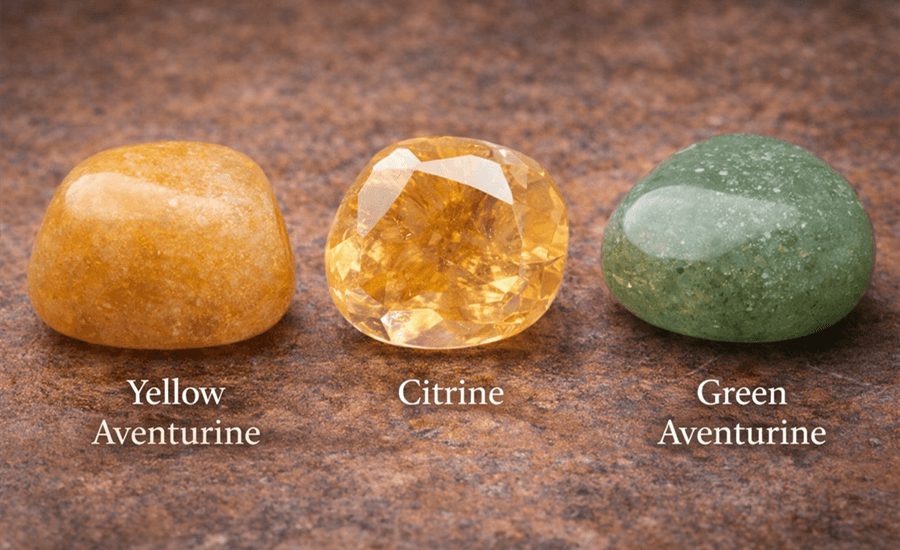
This is one of the most important comparisons, because yellow aventurine and citrine are often grouped together simply because both are yellow members of the quartz family. But visually and commercially, they are quite different stones.
| Feature | Yellow Aventurine | Citrine |
|---|---|---|
| Basic type | Quartz-based aventurine with reflective inclusions | Transparent yellow-to-orange quartz |
| Look | Usually translucent to opaque, softly glittery | Usually transparent, glassy, bright |
| Main visual effect | Aventurescence (sparkling sheen) | Clarity, brilliance, and color zoning |
| Common cuts | Beads, cabochons, carvings | Faceted stones, calibrated gems, some cabochons |
| Market profile | Affordable ornamental and jewelry stone | Mainstream faceted yellow gemstone; natural material is rarer |
Citrine is the transparent pale yellow to brownish orange variety of quartz. It is rarer in nature than many people realize, and much of the citrine on the market is heat-treated amethyst. It is also a top-selling yellow-to-orange gemstone and is commonly valued for eye-clean clarity and faceted jewelry use. Yellow aventurine, by contrast, is prized for its inclusions and shimmer, not for transparency. If you want a bright, clear yellow gemstone for a faceted ring, citrine is usually the better fit. If you want a softer, earthier yellow with sparkle and a lower price point, yellow aventurine makes more sense.
Another practical difference is mood. Citrine tends to look more polished, sunny, and jewel-like. Yellow aventurine tends to look more natural, grounded, and textural. They overlap in color family, but they do not create the same visual effect.
Yellow aventurine vs. green aventurine
Yellow aventurine and green aventurine are much closer relatives. Both belong to the aventurine family and both get their character from inclusions that create shimmer. The main difference is color and the inclusions that produce it. Green aventurine is the most common form and is strongly associated with green fuchsite mica, while yellow aventurine is linked in different descriptions to mica, muscovite, pyrite, goethite, or related inclusions that shift the stone into yellow tones.
In the jewelry market, green aventurine is much more common and easier to find. It is also the variety most often associated with the nickname “stone of opportunity.” Yellow aventurine is usually framed as more personal, more solar, and more focused on confidence, self-worth, decisiveness, and purposeful action. In simple terms, green aventurine is commonly marketed as heart-centered and luck-oriented, while yellow aventurine is marketed as will-centered and confidence-oriented.
If you like aventurine mainly for the material itself, the choice between green and yellow is mostly aesthetic. If you care about crystal symbolism, then the choice is usually emotional: green for soothing and opportunity, yellow for motivation and personal power.
What kinds of jewelry yellow aventurine can be made into
Yellow aventurine is well suited to jewelry because it is durable, takes a good polish, and looks attractive in rounded or domed shapes. It is most commonly used in bracelets, bead necklaces, pendants, earrings, cabochon rings, and simple polished drops. It is commonly used in rings, necklaces, bracelets, and earrings rather than being treated as a classic faceted transparent stone.
Bracelets are especially common because the stone is easy to cut into uniform round beads and wears comfortably. Pendants also work well, especially when the stone has a nice patch of shimmer. Cabochon rings can look beautiful, particularly in silver or warm gold-toned settings, where the yellow body color appears richer. Earrings are possible too, though many designers prefer smaller matched beads or carved drops instead of large heavy stones.
Because yellow aventurine is usually not transparent like citrine, it is not normally chosen for high-sparkle faceting in the same way. Its charm lies in surface glow, polish, and natural texture. That makes it particularly attractive in bohemian, earthy, spiritual, artisan, and everyday-casual jewelry styles.
How people use yellow aventurine
There are two main ways people use yellow aventurine. The first is purely decorative or wearable. They use it in jewelry, desk stones, bowls, carvings, worry stones, and gift items because they enjoy its warm color and approachable price. The second is symbolic or spiritual. In that setting, people may wear it as a bracelet, hold it during meditation, place it in a work area, or keep it near them as a reminder of confidence, discipline, courage, and positive direction.
It is also a practical stone for beginners. Because it is durable and affordable, many people are comfortable carrying it daily without feeling that they are risking a very expensive gem. That everyday usability is part of its appeal.
Who yellow aventurine is suitable for
Yellow aventurine is a good choice for several kinds of people. It suits people who want a yellow gemstone but prefer something softer and less flashy than citrine. It suits people who like natural-looking stones with inclusions and shimmer. It suits jewelry lovers who want an affordable quartz-based material for casual wear. And in crystal practice, it especially suits people who are working on confidence, self-expression, decisiveness, motivation, and stepping into leadership more comfortably.
It can also be a very fitting stone for students, creatives, entrepreneurs, public speakers, or anyone going through a period that requires more courage and self-belief. That does not mean the stone itself changes a person’s life. It means its symbolism often resonates with people who want a visual and tactile reminder of those qualities.
On the other hand, it may not be the best choice for someone who wants a classic fine-jewelry look with brilliance and transparency. In that case, citrine, yellow sapphire, or even yellow topaz may feel more satisfying. Yellow aventurine is at its best when it is appreciated for what it is: warm, earthy, gently sparkling, and quietly encouraging.
What to watch out for when buying
When buying yellow aventurine, it helps to know what not to confuse it with. True aventurine is a natural quartz-based stone, while aventurine glass, also called goldstone, is a synthetic glittering glass material. You may also see heavily dyed or treated material in the market, especially in lower-end bead trade, so it is worth asking sellers whether the stone is natural, dyed, or enhanced.
Visually, the best yellow aventurine pieces usually show an attractive yellow body color, a pleasant polish, and a natural-looking shimmer rather than a flat, chalky, or plasticky appearance. If you want a more gemstone-like look, choose better-polished cabochons or cleaner matched beads. If you want a more earthy or spiritual look, tumbled stones and carved pendants can work beautifully.
Final thoughts
Yellow aventurine is not the most famous yellow stone, but that is part of its charm. It sits in an appealing middle ground: more textured and grounded than citrine, less common than green aventurine, more affordable than most classic yellow gems, and rich in symbolism for people who enjoy crystal traditions. Material-wise, it is a quartz-based aventurine with reflective inclusions and enough hardness for regular jewelry use. Market-wise, it is usually accessible in price. Spiritually, it is most often linked with confidence, personal will, optimism, and the solar plexus. And stylistically, it works best in beads, cabochons, pendants, bracelets, and other designs that let its soft shimmer speak for itself.
If you understand those basics, yellow aventurine becomes much easier to place. It is not trying to be citrine, and it is not simply “green aventurine in yellow.” It is its own stone: warm, practical, symbolic, and quietly beautiful.