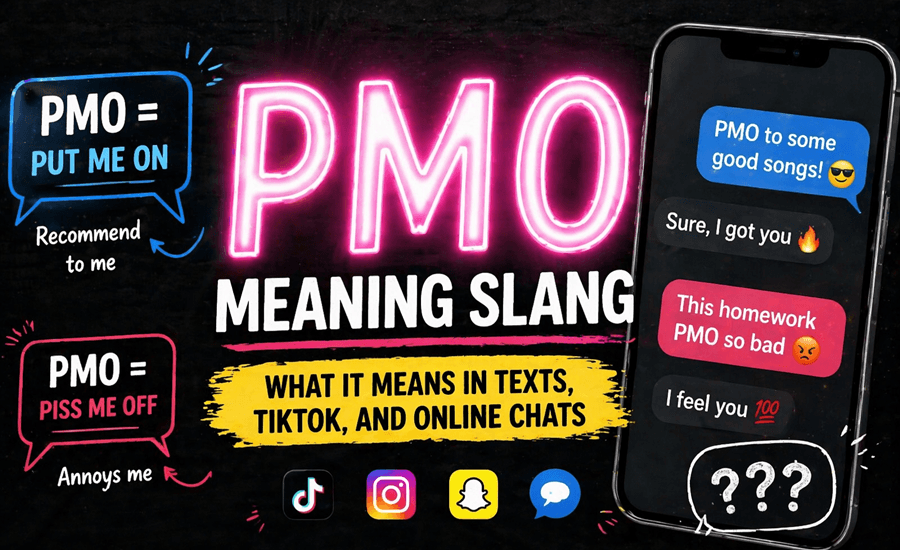
PMO Meaning Slang: What It Means in Texts, TikTok, and Online Chats

If you have seen PMO in a text, comment, or caption and felt unsure what it meant, you are not alone. PMO is one of those slang terms that can mean different things depending on the sentence. In current online use, the two most common meanings are “put me on” and “piss me off” / “pissing me off.” The right meaning depends almost entirely on context. (Know Your Meme)
That is what makes PMO tricky. It can sound friendly in one message and annoyed in the next. If someone says, “PMO to more songs like this,” they usually mean “put me on,” or “recommend more songs like this.” But if someone says, “This PMO,” they usually mean “this pisses me off.” (my-symbian.com)
What does PMO usually mean in slang?
In slang, PMO often means “put me on.” This is a casual way of asking someone to introduce you to something, recommend something, connect you with someone, or show you where to find something good. It can be used for music, fashion, trends, food, jobs, people, or just about anything else someone wants access to. (Know Your Meme)
For example, if someone says:
“PMO to that playlist.”
they usually mean:
“Put me on to that playlist,” or “send me more music like that.”
If someone says:
“PMO to some good skincare products.”
they usually mean:
“Recommend some good skincare products to me.”
This version of PMO sounds curious, social, and slightly upbeat. It is often used when someone wants to be included, informed, or introduced to something worth knowing.
PMO can also mean “piss me off”
The other very common slang meaning of PMO is “piss me off” or “pissing me off.” In this case, the tone is completely different. Instead of asking for a recommendation or connection, the person is expressing irritation, frustration, or anger. Current explainers and slang coverage note that both meanings are active online, and some sources say the annoyed meaning has been especially common in recent meme-heavy use, particularly in phrases like “ts pmo.” (Know Your Meme)
For example:
“This app PMO.”
usually means:
“This app pisses me off.”
And:
“ICL ts pmo”
usually expands to something like:
“I can’t lie, this stuff is pissing me off.”
That is why PMO can confuse readers so easily. The same three letters can express either interest or annoyance. You have to look at the emotional tone of the sentence to know which one the person means.
How to tell which meaning is correct
The easiest way to figure out PMO is to look at the words around it.
If the sentence sounds like a request, PMO usually means put me on.
If the sentence sounds like a complaint, PMO usually means piss me off.
Here is a simple way to think about it:
“PMO to that brand”
means “recommend that brand to me.”
“This homework PMO”
means “this homework annoys me.”
“PMO to some new shows”
means “put me on to some new shows.”
“People like that PMO”
means “people like that piss me off.”
Once you notice that pattern, the term becomes much easier to read.
PMO meaning on TikTok
On TikTok, PMO is commonly used in both senses, but “put me on” is especially easy to spot in comments and captions. People use it when they want more information, better recommendations, or access to whatever the creator is showing. Examples from current slang explainers include comments like “PMO to more songs like this,” where the meaning is clearly “recommend more of this to me.” (my-symbian.com)
That makes sense on TikTok, because the platform is built around discovery. Users are constantly asking each other for product links, music recommendations, book suggestions, beauty routines, and niche interests. In that setting, PMO feels natural because it is short, casual, and very direct.
At the same time, TikTok also helped spread irritated uses like “ts pmo,” where the tone is clearly negative. In other words, TikTok did not create only one PMO meaning. It helped popularize both.
PMO meaning in texting
In private messages and group chats, PMO can swing between both meanings even more quickly.
If a friend texts:
“PMO to that restaurant.”
they are probably asking for the name, the location, or a recommendation.
If a friend texts:
“Bro this PMO.”
they are probably complaining about something that annoyed them.
Texting makes slang more flexible because people assume shared context. That means they often do not bother explaining which meaning they intend. They assume the other person will understand from tone, relationship, or topic.
That is why PMO can feel obvious to some people and confusing to others. If you are already used to texting slang, it reads naturally. If you are not, it can look like one abbreviation with too many meanings.
Why PMO became popular
Like a lot of internet slang, PMO became popular because it is short, adaptable, and socially expressive. It saves time, but more importantly, it sounds current. Online slang often spreads not because people need shorter words, but because those words create a certain tone. PMO feels casual, fast, and plugged into digital conversation.
It also works well because both meanings are useful. “Put me on” gives people a way to ask for recommendations or introductions without sounding formal. “Piss me off” gives people a quick shorthand for irritation. Both fit naturally into texts, comments, memes, and captions.
That flexibility is part of the reason slang like PMO lasts. A term that can be used in more than one emotional direction tends to spread faster.
Does PMO have other meanings?
Yes, PMO can have other meanings outside slang. In formal or workplace settings, people may use PMO for things like Project Management Office. But in social media, texting, and youth slang, that is usually not what people mean. Current slang explainers focus mainly on the two casual meanings: put me on and piss me off. (Linguisticss)
So if you are reading TikTok comments, Instagram captions, or casual texts, it is usually safest to assume the slang meaning first and then check the sentence for tone.
Example sentences that make PMO easier to understand
Here are a few simple examples:
“PMO to more artists like this.”
This means: recommend more artists like this.
“She always PMO to good movies.”
This means: she always introduces me to good movies.
“This slow internet really PMO.”
This means: this slow internet really annoys me.
“Why do people act like that? It PMO.”
This means: it makes me irritated.
“PMO to some good thrift stores.”
This means: tell me some good thrift stores.
In all of these cases, the meaning becomes clear once you ask one question: is the person asking or complaining?
Should you use PMO yourself?
You can, but it works best in informal conversation. It fits naturally in texts, DMs, TikTok comments, and casual online chats. It is much less suitable for anything professional, academic, or formal. If you use it with people who are not familiar with internet slang, they may misunderstand it or not know what you mean at all.
It is also worth paying attention to tone. “Put me on” is usually playful or friendly. “Piss me off” is obviously sharper. Using PMO without context can sometimes make a message sound more aggressive than you intended, especially if the other person reads the wrong meaning first.
Final answer
If you are asking what PMO means in slang, the clearest answer is this: it usually means either “put me on” or “piss me off / pissing me off.” Both meanings are common in current online use, and the only reliable way to tell which one is meant is to read the sentence around it. If the message is asking for a recommendation, introduction, or connection, it means put me on. If the message sounds irritated or fed up, it means piss me off. (Know Your Meme)
That may sound messy, but it is actually how a lot of modern slang works. The letters stay the same, but the tone changes everything.