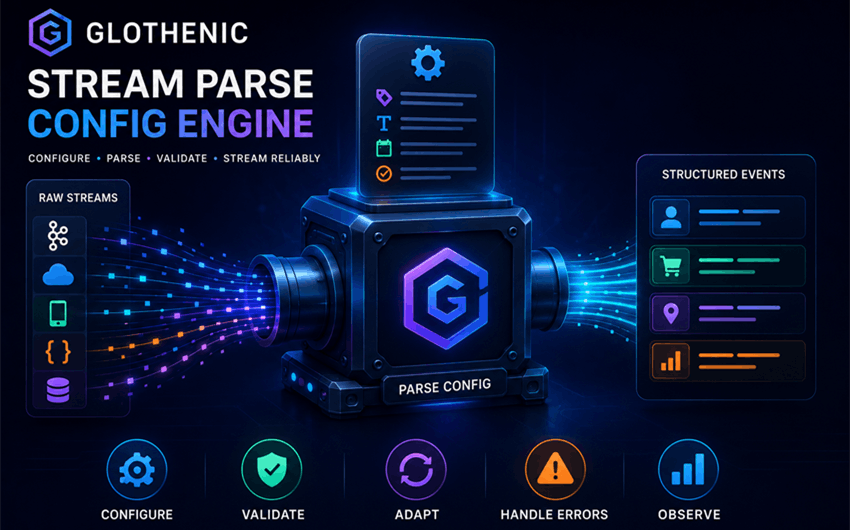
Glothenic Stream Parse Config Engine: A Practical Guide to Stream Parsing Control

Glothenic Stream Parse Config Engine is a configuration layer for systems that need to parse continuous streams of data reliably. It is designed for pipelines where event formats change, producers behave differently, and downstream systems depend on clean, predictable records.
In a streaming architecture, data does not arrive once and wait quietly for review. It moves constantly through topics, queues, event buses, telemetry feeds, webhooks, logs, and real-time processors. Each message has to be read, interpreted, validated, and shaped before another system can use it.
That is where stream parsing becomes important.
A stream parser takes raw incoming data and turns it into structured information. A parse config tells the parser how to do that work. It may define field names, data types, timestamp formats, nested object paths, default values, required fields, version rules, and error-handling behavior.
Glothenic brings those parsing rules into one controlled engine. Instead of scattering parsing logic across many services, it gives teams a central place to manage how stream data is understood.
What Glothenic Stream Parse Config Engine Does
Glothenic controls how live event data is parsed before it reaches downstream systems.
For example, an application may receive a raw event like this:
{"event":"checkout_completed","userId":"4819","amount":"29.99","createdAt":"2026-06-11T12:10:00Z"}
A downstream analytics system may expect a cleaner internal format:
event_name, user_id, purchase_amount, and event_time.
Glothenic handles that translation through a parse configuration. The config defines which fields to extract, how to rename them, which values to convert, and how to validate the final record.
This matters because streaming systems often have many producers and consumers. One service may send userId, another may send user_id, and another may nest the same value under account.user.id. Without a central parsing layer, every consumer has to solve the same problem separately.
Glothenic reduces that duplication. It lets teams define the parsing rules once, apply them consistently, and update them safely when event formats change.
Why Stream Parsing Fails in Real Systems
Stream parsing usually fails for simple reasons, but the effects can spread quickly.
A producer may rename a field. A mobile app may start sending a number as a string. A third-party webhook may add a new event type. A firmware update may change the structure of telemetry data. A backend service may stop sending a field that used to be required.
Any of these changes can break a downstream consumer.
The risk is higher in streaming systems because events move continuously. If a parsing rule is wrong, bad data can flow into dashboards, alerts, fraud systems, billing logic, search indexes, machine learning features, and audit logs before anyone notices.
Glothenic is meant to catch and control those changes at the parsing layer.
It does not stop event formats from evolving. Instead, it gives teams a safer way to manage that evolution.
How Glothenic Works
Glothenic follows a clear processing path.
First, it receives or observes incoming stream events. These events may come from Kafka topics, queue messages, webhooks, logs, application events, device telemetry, or internal service calls.
Next, it identifies the event type. This can be based on topic name, payload fields, headers, schema ID, source service, route, or metadata.
After that, Glothenic selects the correct parse config. The config tells the engine how to read the payload, which fields matter, which types are expected, and where the parsed event should go.
Then the engine validates the event. It checks required fields, data types, timestamp formats, enum values, nested structures, and version compatibility.
If the event is valid, Glothenic normalizes it into the expected internal format and passes it forward. If the event is invalid, it can reject it, quarantine it, send it to a dead-letter stream, or flag it for review.
This workflow keeps bad data from quietly contaminating the rest of the pipeline.
Parse Configs as Managed Assets
A strong part of Glothenic’s design is treating parse configs as managed assets, not loose code snippets.
A parse config should have a version, owner, changelog, test result, and rollback path. This is important because parsing rules affect production data. A small config mistake can break a large number of records.
For example, a team may manage a payment.completed event with several versions.
Version 1 may include payment_id, customer_id, amount, and currency.
Version 2 may add tax_amount and discount_code.
Version 3 may change the timestamp format or add regional payment metadata.
Glothenic allows these versions to exist clearly. Older events can still be parsed with older rules, while newer events use updated logic. That is critical in real systems because old and new event shapes often appear at the same time during deployments, client updates, or third-party migrations.
Schema Validation and Field Mapping
Glothenic’s main job is not just reading fields. It also checks whether those fields make sense.
Schema validation answers practical questions:
Is the required ID present?
Is the amount a number?
Is the timestamp valid?
Is the event name allowed?
Is the nested object shaped correctly?
Is the producer sending a supported version?
Field mapping solves a different but related problem. It standardizes different producer formats into one internal shape.
For example:
customerId
customer_id
customer.id
These may all represent the same value. Glothenic can map them into one field, such as customer_id, before downstream systems receive the event.
That makes the rest of the data stack easier to maintain. Consumers do not need custom parsing logic for every source. They receive consistent records and can focus on their actual job.
Safe Config Rollouts
Changing parse rules in a live stream is risky. A bad rule can reject valid data, misread important fields, or flood error queues.
Glothenic should support controlled rollout patterns.
A new config can first run in shadow mode. In this mode, the engine tests the new rule against real events but does not affect the live output. It reports what would have passed, failed, changed, or been routed differently.
If the results look safe, the team can roll out the config to a small portion of the stream. If error rates stay normal, the rollout can expand.
If the new config causes problems, Glothenic can return to the previous version.
This approach gives teams more confidence when updating parsing logic. They do not have to choose between moving fast and protecting the pipeline.
Error Handling and Dead-Letter Routing
Not every malformed event should be handled the same way.
Some problems are minor. A missing optional field may only need a warning. Other problems are serious. A missing account ID, invalid payment amount, or broken timestamp may require rejection.
Glothenic can route failed events based on rule severity.
A low-risk issue might be logged and passed forward with a default value. A high-risk issue might be sent to a dead-letter stream. A sudden spike in failures might trigger an alert.
Dead-letter routing is especially useful because it preserves bad events for review. Engineers can inspect the original payload, identify the producer or config issue, update the rule, and replay the event if needed.
This avoids two bad outcomes: silently accepting broken data or permanently losing events that could be repaired.
Observability for Parse Rules
Parsing needs its own observability.
Glothenic should track parse success rates, failure rates, unknown fields, rejected events, config version usage, schema mismatches, producer-specific errors, and dead-letter volume.
These signals help teams answer direct operational questions:
Which event type is failing most often?
Did a new config increase errors?
Which producer is sending unexpected fields?
Are old event versions still active?
Is a downstream system receiving the format it expects?
Without this visibility, parse problems often look like generic pipeline failures. With it, teams can quickly see whether the issue is a producer change, schema mismatch, config mistake, or downstream expectation problem.
Where Glothenic Fits in a Data Pipeline
Glothenic does not replace a stream platform or processing framework.
Kafka, queues, event buses, and streaming engines move and process data. Glothenic focuses on the parsing and configuration layer. It sits near the point where raw stream data becomes structured, validated data.
A typical flow looks like this:
A producer sends an event. Glothenic identifies the event type, applies the correct parse config, validates the payload, normalizes the output, and routes the cleaned record to downstream processors, storage systems, dashboards, or services.
That separation is useful. The stream platform handles movement. Processing systems handle transformation and computation. Glothenic handles the rules for interpreting the incoming record correctly.
Who Needs Glothenic
A small application with a few stable event types may not need a dedicated parse config engine. Simple consumer-side parsing can be enough.
Glothenic becomes valuable when a system has many producers, many event types, frequent schema changes, strict data quality requirements, or repeated parsing failures.
It fits well in SaaS platforms, IoT systems, fintech pipelines, analytics platforms, log aggregation systems, event-driven microservices, and real-time operational data stacks.
The more systems depend on the same stream data, the more important parsing control becomes.
Final Takeaway
Glothenic Stream Parse Config Engine addresses a specific but important problem: making sure live stream data is parsed correctly before other systems depend on it.
It centralizes parse rules, validates schemas, maps inconsistent fields, supports versioned configs, manages safe rollouts, handles malformed events, and monitors parsing behavior.
That gives engineering teams more control over a fragile part of the data pipeline.
Streams move fast. Event formats change. Producers drift. Consumers expect consistency. Glothenic provides the layer that keeps raw incoming data understandable, reliable, and safe to use.