Why cybersecurity belongs in every industrial control lab

A training lab should do more than make a motor turn or a sensor report a value. It should help learners understand what happens when connected equipment receives the wrong command, an unauthorized user reaches a controller, or a routine configuration change introduces an unexpected risk. That is why cybersecurity should sit right there beside wiring, programming, diagnostics, and safety from the first lab session – and not just appear as an optional topic at the end of a course.
The lesson has moved from the screen to the physical world
In a conventional computer lab, a security mistake may interrupt a digital service. In an automation lab, digital instructions can influence pumps, conveyors, valves, temperature controls, and robots. Learners therefore need to understand that operational technology is not simply another form of IT. Its priorities include safe behavior, continuity, predictable timing, and recovery without creating a physical hazard.
This is particularly important when older equipment meets modern networking tools. Many legacy control environments were designed around reliability and operability rather than cybersecurity. Some still use outdated operating systems and protocols that lack encryption or authentication today. A well-designed lab makes that reality manageable. Students can first observe how a normal control sequence behaves and then investigate a safe, simulated deviation without placing production equipment at risk.
Secure thinking should begin with the components
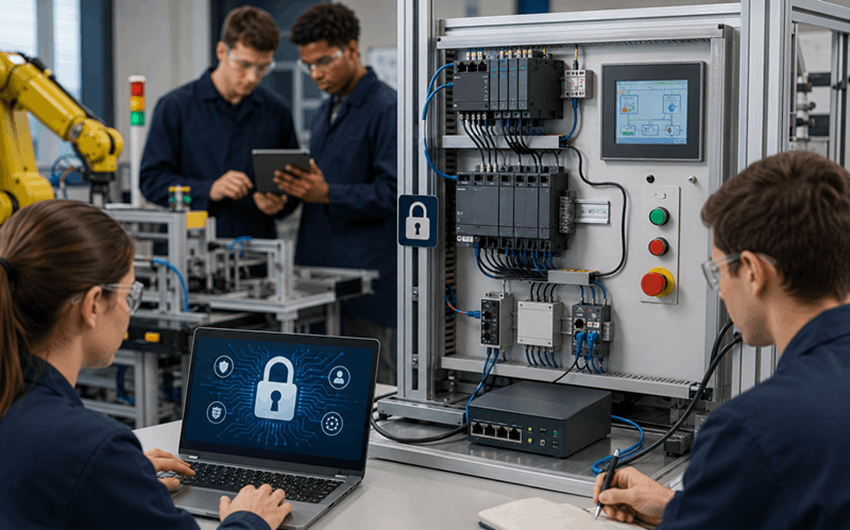
Cybersecurity becomes easier to understand when learners can connect an abstract rule to a device in front of them. Before assembling a training rig, instructors can ask the class to identify what the system contains, what each item communicates with, and which connections are genuinely necessary. A resource such as RS’s overview of industrial controls can support this preparation by introducing system types and components, including controllers, communication devices, safety equipment, and panel instruments. The important learning begins with the questions that follow. Does the controller require external access? Is a default credential still enabled? Which workstation should be permitted to alter its logic? What activity needs to be logged?
A good exercise is safe, specific, and observable
Industrial cybersecurity education does not require dramatic attack demonstrations. In fact, the most useful introductory exercises are often small and tightly controlled. One team might create an asset list and a simple map of permitted connections. Another could compare a secure configuration with one containing an unnecessary open service.
Learners might review a prepared log, identify an unexpected login, or explain why an engineering workstation shouldn’t have unrestricted access to every device. They can then practice a basic response: pause the exercise, preserve the available evidence, communicate the issue, restore a known-good configuration, and confirm that the physical process is stable. These activities develop technical judgment without encouraging unsafe experimentation. They also demonstrate why monitoring matters: Equipment data can help technicians distinguish normal performance from emerging problems. Applied to cybersecurity, the same principle helps learners decide whether a change in a command, connection, account, or configuration deserves investigation.
Labs can connect automation and security teams
The most valuable outcome may be cultural rather than technical. Automation students learn why a security colleague asks about network separation, user accounts, and logs. Cybersecurity students learn why an operator cannot always reboot or patch a controller in the middle of a physical process.
PwC’s 2026 study of 816 leaders in industrial products found that attacks on connected products were the cyber threat respondents felt least prepared to address. It also found that only 25% were spending significantly more on proactive security than on reactive measures. A lab cannot determine an organization’s budget, but it can prepare future professionals to make better-informed decisions. Assessment should therefore reward more than a functioning control loop. Learners can document assets, justify access choices, identify a safe recovery point, and explain the operational effect of a proposed security measure.
When cybersecurity forms part of the grading criteria, secure operation stops looking like somebody else’s job and becomes part of competent engineering.