How NextPage Uses Variable Data Printing For Personalized Campaigns

Consider a mailbox overflowing with pamphlets for “Current Resident” — impersonal, boring, and tossed straight into the recycling bin without even being opened. Most direct mail is not even given the chance to catch a potential customer’s attention simply because it was clearly designed for everyone.
Marketers attempt to compensate for this obvious problem in the most obvious manner: produce more pieces of mail, give them a more attractive headline, and hope that sheer quantity or quality will help in place of the lacking personal touch. Quantity and quality do not solve the problem of the lack of personal touch.
That is why the folks at NextPage have decided to take another path in their marketing efforts using the technique called variable data printing, giving each piece of mail a personal touch.
But how does this work?
How can you produce a personalized piece of mail in one print run?
Keep reading.
1. Personalization Goes Far Beyond a First Name
Typical mail merge basically ends here. That said, the rest of the content is going to come across as generic, despite the personalization that happens through the greetings.
Variable data printing takes things much farther beyond there, with names, messages, offers, and even graphics being personalized per individual piece printed.
The NextPage campaigns are based on all of these aspects of personalization, rather than only the skin-deep customizations. In other words, one recipient gets a product offer while another one gets a completely different message, and everything is printed at once.
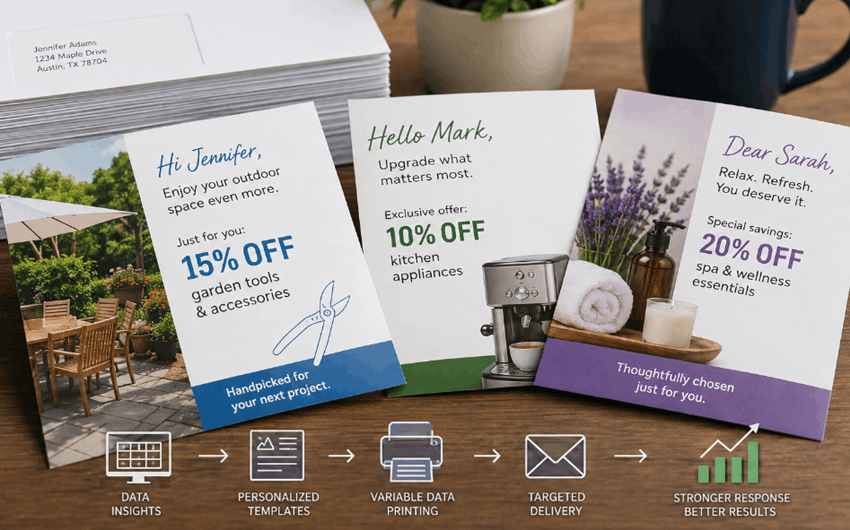
If someone just bought patio furniture, they would see a discount on garden tools, whereas someone who has a purchase history of appliances will see an entirely different set of items – all printed in one run.
It is important to realize how deep personalization should be because true relevance can be achieved by taking into account the context rather than simply adding a name to the greeting line.
2. Clear Workflow Keeps Personalization Accurate
It can sound scary to personalize hundreds or thousands of pieces without having a process in place. That is why so many companies refrain from implementing VDP out of fear of incorrect names, offers or formats.
With a process in place, you can be sure of no risk of errors. Data import, template creation, merging and proofing, printing production, mailing preparation and quality control each perform a unique task needed for perfect personalization. It is in this area where mismatches in name or incorrect offers tend to occur unnoticed by the system.
NextPage has always followed such an exact order of things when implementing campaigns, beginning with validation of data lists prior to any action taken with templates.
The reason why they take this approach is to prevent mistakes leading to negative results of personalization, which will make you better off without it at all.
3. Printing Only What’s Needed Cuts Waste
The number of pages that are printed through traditional print runs usually exceeds the actual requirement for a campaign. In such a case, firms wind up having to pay for materials that never get to see the light of day because they are eventually thrown away without any use at all.
With digital printing, however, the situation is different. This is due to the fact that since pages are not printed in bulk but rather on a per-page basis, the required number will be printed.
As for NextPage, its use of digital presses allows for this per-page printing method. For example, even small mailing lists will not have to go through a bulk print run because of setup fees.
4. Relevance Drives Stronger Engagement and ROI
A generic mailer finds itself battling with several other generic mailers for a few precious seconds of the customer’s time. Therefore, response rates on non-personalized mailers usually remain dismally low.
However, targeted messaging turns the tables on the situation. The fact is that content relevant to an individual naturally enjoys higher engagement levels compared to content that is not personalized.
The NextPage process uses its understanding of data and print technology to ensure that there is greater engagement because of increased relevancy. A campaign, for instance, tailored to the interests of the segment is more likely to yield conversions compared to a generic version sent out to all. Even a small increase in response rate can compensate for the cost of segmentation several times over.
Increased engagement means increased response, which in turn results in increased ROI, since less effort would be wasted on irrelevant customers.
5. Print and Digital Work Together, Not Apart
Print marketing and digital marketing campaigns tend to operate independently of each other. This creates an opportunity for brands to take advantage of a unified messaging strategy for both marketing channels.
Integration of multiple channels helps overcome this problem through the use of variable data printing in conjunction with delivery tracking and a digital marketing campaign that becomes an integrated single campaign instead of a set of unrelated initiatives.
The company NextPage incorporates such integration within its operations, linking individualized print with the tracking of delivery and related digital elements. An individual customer may get a personalized postcard and see an advertisement online that corresponds to the printed offer. It also allows you to know which message worked and led to action.
This integration allows for better campaign performance because of the repetition of the same relevant message through various marketing channels.
Personalization That Actually Performs
Variable Data Printing transforms one print job into hundreds of separate conversations, conversations that are based on actual data instead of assumptions. From personalization to efficient production and expanded multichannel delivery, all efforts have been made to create something more targeted than just sending out a mailing.
Prior to your next print job, think about how much of your copy is going to be perceived as impersonal. It may surprise you to know that sometimes the only thing that makes the difference between getting ignored and getting read is personalization.