Bathroom Lighting Height Rules: Vanity Lights and Mirrors Done Right

Bathroom lighting can make a clean, upgraded vanity look disappointing fast. The problem is usually not the fixture itself. It is the height, the spacing, and where the light lands on your face. If the light sits too high, it creates shadows under eyes and chin. If it is too low, it can glare in the mirror.
This guide covers practical bathroom lighting height rules U.S. homeowners use for vanity lights and mirrors, plus quick fixes if your current setup feels too dim, too harsh, or off-center.
What You’re Actually Trying to Achieve at the Vanity
The best bathroom lighting is not “brightest possible.” It is:
• Even on the face (minimal shadows under the eyes and jawline)
• Comfortable in the mirror (no exposed glare points)
• Consistent (similar tone and brightness each time you get ready)
Height rules exist to support those goals, not to make your bathroom follow a strict formula.
The Golden Rule: Side Lighting Beats Top-Only Lighting
If you have ever done makeup or shaved under a single light above the mirror, you know the issue: shadows appear exactly where you do not want them.
For many bathrooms, the most flattering setup is:
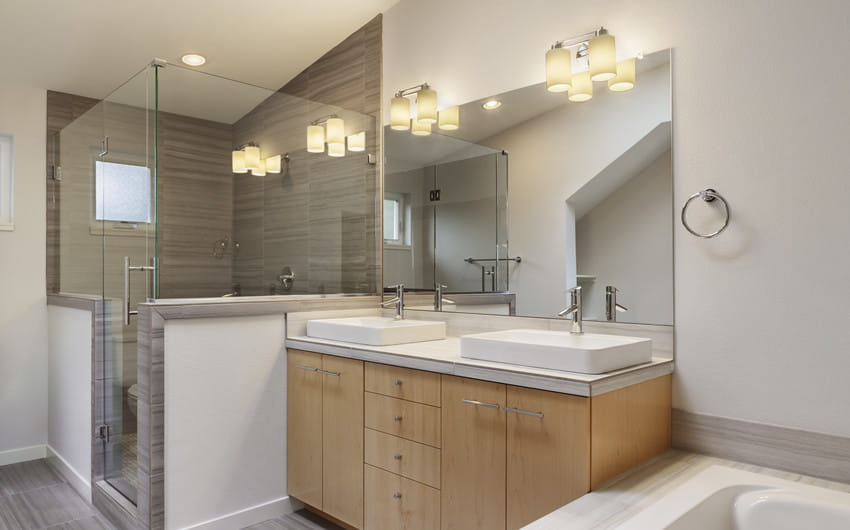
• Two vertical lights on the left and right of the mirror (sconces), or
• A vanity bar that has light sources spread wide enough to reach both sides of the face.
Bathroom Sconce Height Rules (Lights on the Sides of the Mirror)
Side sconces are often the best “done right” option because they brighten your face evenly. Here are the practical placement targets most installers use in U.S. bathrooms:
Height
• Mount the center of the sconce around 60–66 inches from the finished floor. Adjust slightly based on who uses the bathroom most. If the household is tall, lean higher within that range.
• In bathrooms with very tall mirrors, it is also acceptable to align the sconce vertically with the main face area rather than the mirror top.
Distance from the mirror edge
• A common target is about 2–5 inches from the side edge of the mirror (depending on the sconce width). The goal is light close enough to the mirror to hit the face, but not so close that the fixture looks cramped.
Spacing between two sconces
• Position the pair so they frame the mirror evenly. If the sconces are too far apart, the face can still end up lit mainly from the center.
If your bathroom is narrow, vertical sconces with diffusers are especially helpful because they give light without throwing harsh glare into the mirror.
Vanity Light Bar Height Rules (Light Above the Mirror)
Many U.S. bathrooms have a single vanity bar above the mirror. This can work well if the height is correct and the fixture spreads light evenly.
How high above the mirror?
• A widely used guideline is to mount the fixture so the bulbs sit roughly 75–80 inches from the floor, depending on ceiling height and mirror size.
• If your mirror is tall, leave a small gap above it so the fixture is not pressed against the mirror frame.
Why “too high” feels bad
When the light bar is mounted very high, it acts like overhead lighting and throws shadows down the face. That is why many people feel they look more tired in the bathroom mirror than they do in daylight.
Light bar length vs mirror width
• For most bathrooms, a vanity bar looks balanced when it is close to the mirror width, or at least wide enough to spread light toward both sides of your face.
Mirror Size and Shape: A Simple Compatibility Check
Mirror proportion changes what “done right” looks like. Use these quick checks:
• Wide mirrors: side sconces often look best and improve face lighting.
• Tall mirrors: pay extra attention to sconce height so the beam hits the face zone, not just the top half of the glass.
• Framed mirrors: allow enough clearance so the frame does not block light.
Color Temperature and Brightness: The Choices That Affect Your Face
Height gets the light in the right place, but bulb choice determines how it feels.
Color temperature
• 3000K: a balanced choice for most bathrooms, warm enough to feel residential, clean enough for grooming.
• 3500K–4000K: useful for detailed makeup or shaving, but can look a bit clinical if the rest of the home is very warm.
Brightness
• If the mirror area feels dim, it is often better to add side light or use a wider fixture than to install one very harsh bulb.
• A dimmer helps a lot: brighter for cleaning and detail work, softer for late-night use.
Common Bathroom Lighting Mistakes (and Quick Fixes)
Mistake: One ceiling light doing everything
Quick fix: add a vanity light or sconces. Even a modest vanity fixture changes how the face is lit.
Mistake: Exposed bulbs causing glare in the mirror
Quick fix: choose diffused shades or frosted glass, or swap to bulbs with lower glare output.
Mistake: Vanity light centered in the room, not over the mirror
Quick fix: align the fixture to the mirror and sink area, not the wall space. The mirror is the working surface.
Mistake: Fixture too small for the mirror
Quick fix: move to a wider bar or add side sconces so light reaches both sides of the face evenly.
A “Done Right” Bathroom Setup You Can Copy
If you want a simple target layout that works in many U.S. bathrooms:
1. Use two sconces on the sides of the mirror (when space allows).
2. Mount the sconce centers around 60–66 inches from the floor.
3. Use 3000K bulbs for a natural look, with a dimmer for flexibility.
4. Keep overhead lighting separate as a general room light, not the main grooming light.
This creates a bathroom mirror experience that feels closer to flattering daylight, without the harshness.
Choosing Fixtures That Fit Your Bathroom Style
Once you know the height rules and the bulb targets, the fixture choice becomes much easier because you can shop with a clear plan. If you are comparing modern vanity lights, wall sconces, and coordinating fixtures for other rooms in the home, you can browse lighting collections from Seus Lighting. A bathroom feels more finished when the mirror lighting is placed correctly and the look ties into the rest of the home.