Lead Capture for Events: Smarter Ways to Convert Attendees

Most event organizers prioritize getting people through the door, but don’t know how to make the most use of those contacts. You’ve spent months planning, thousands on logistics, and days on your feet, only to end up with a pile of business cards and a spreadsheet that nobody acts on.
If this resonates, revisit your strategies and tweak them. This article walks you through smarter, more intentional approaches to lead capture, from the tools you use on the floor to how you set up your team for success before and after the event.
Stop Treating Lead Capture as an Afterthought
Treating lead capture as a last-minute checkbox is counterproductive. You bring a stack of paper sign-up sheets or rely on collected business cards. By the time the event ends, half that information becomes illegible or incomplete. It’s the kind of problem that a well-structured event lead capture strategy can solve. It systematizes the process, so no contact slips through the cracks.
Not every attendee is worth the same follow-up effort. So, think about what you actually need from each interaction. Before the event, work with your sales team to agree on lead qualifiers. List the specific criteria that distinguish a serious prospect from someone who just grabbed a free pen. These could be job title, company size, budget authority, or timeline. When your booth staff knows what to listen for, they can prioritize more effectively and collect far more useful lead data.
The Right Tools for the Floor
Technology has completely changed what’s possible at trade shows and field events. Gone are the days when badge scanners were clunky, rental-only devices reserved for the biggest exhibitors. Today, lead retrieval tools run on smartphones and tablets, which means your team has everything they need in their pocket.
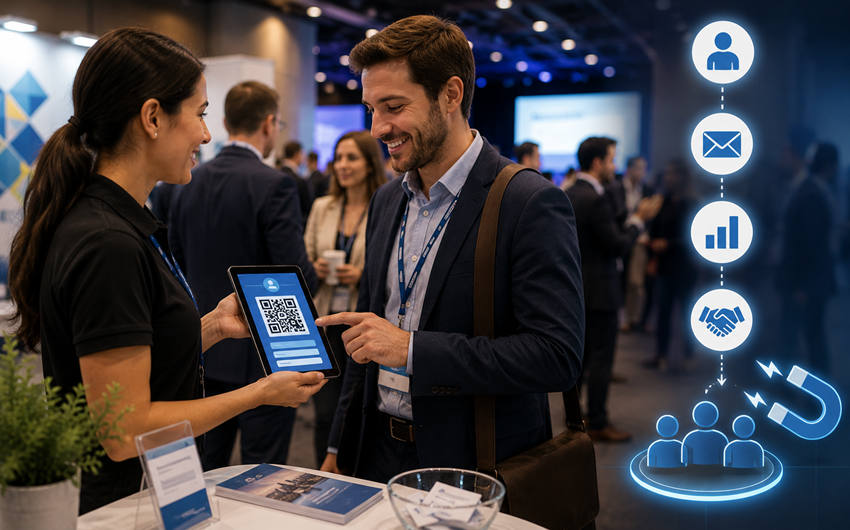
Badge scanners and QR code scanning apps are the workhorses. Most modern events print attendee badges with a QR or barcode that links to the attendee’s registration details. When a rep scans a show badge, the contact information—name, title, company, email—populates automatically.
This eliminates manual entry errors and speeds up every conversation. Many exhibitor lead capture platforms also let you add custom qualification questions right after a scan, so your team can tag a lead with relevant notes while the conversation is still fresh.
Here’s what a solid on-floor toolkit typically includes:
- Lead scanning tools with custom fields: Look for apps available through your phone’s app store that let you add qualification questions, voice notes, or tags immediately after capturing a lead.
- Touchless solutions: QR codes placed at your booth, on collateral, or on product displays let attendees self-scan with their own mobile phones, reducing friction and keeping the interaction smooth.
These options serve different types of interactions. Active scanning works well for deeper conversations, while self-scan QR codes are perfect for high-traffic moments when you simply can’t engage everyone one-on-one.
Designing Your Booth for Better Conversion
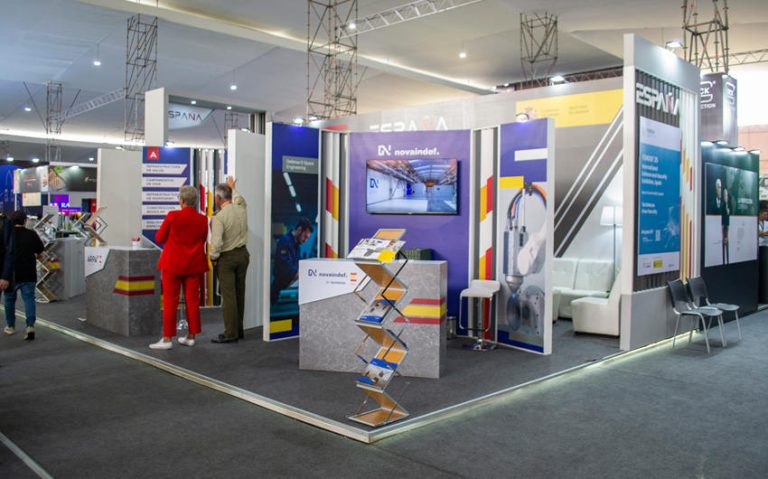
Personal experience matters more than most people realize. When you reinforce branding through physical layout and design, you signal professionalism and make it easier for attendees to understand your offering at a glance. This, in turn, makes lead capture conversations faster and more productive. Attendees arrive at your booth already half-informed, so your rep can skip the basics and get straight to qualification.
Think about how your lead capture forms are positioned, whether digital kiosks are accessible without a staff member present, and whether your event app is prominently promoted in your signage. Small friction points, for instance, a tablet that requires staff to unlock it, or a form that asks too many fields upfront, can kill momentum in a busy hall.
Making Data Actually Useful
Capturing contact information is just the first step. The real value comes from what happens to that data afterward. This is where your CRM system, lead generation software, and enrichment tools earn their keep.
AI enrichment tools can take a basic scan and layer in firmographic data like revenue range, headcount, or tech stack. This gives your reps context before sending the first follow-up email. Combine that with email validation to flag bad addresses immediately, and your list stays clean from the start.
Lead scoring is another layer worth implementing. Assigning scores based on responses to qualification questions, job title, or engagement with your booth materials helps your team triage and prioritize effectively. The contacts who asked detailed product questions get a different follow-up sequence than someone who stopped by for a demo and then left.
Engagement Beyond the Booth
Pre-and post-event engagement is just as important to maximize return on investment. Many brands focus entirely on in-person events themselves, but the weeks before and after often hold more conversion potential than the event floor itself.
Use your event app or email to invite pre-registered attendees to schedule time with your team before the event. Give them a reason to come to your booth, specifically through a product demo, a consultation, or access to exclusive sponsorship offerings.
Lead follow-up timing matters enormously post-event. Research consistently shows that response rates drop sharply after 24–48 hours. Automation tools connected to your CRM can trigger personalized outreach based on the tags your team applied during lead scanning.
Gamification also plays a role. Scavenger hunts and interactive challenges that route attendees through multiple exhibitor booths increase dwell time and generate more qualified engagement than passive foot traffic alone.
Connecting Capture to the Customer Journey
Lead generation doesn’t end when you leave the venue. The contacts you collect at in-person events need to flow cleanly into your broader sales pipeline. Each lead should carry enough conversation context that your reps can pick up exactly where the booth interaction left off.
That means documenting attendee information and the substance of each conversation. Note the problems the prospect mentioned, what products caught their interest, and the objections that came up. When this context travels with the lead into your CRM, your follow-up feels personal rather than generic. That difference is what turns a scanned badge into a closed deal.
The Shift That Changes Everything
Events are expensive. The ROI only materializes when you treat lead capture as a system: connected, intentional, and built around what happens after the handshake.
Get your qualification criteria right before you arrive. Use the scanning tools your team will actually use. Build follow-up sequences before the event starts. The exhibitors who consistently convert attendees into customers aren’t necessarily the ones with the biggest booths. They’re the ones who’ve thought through every step from first scan to first sale.