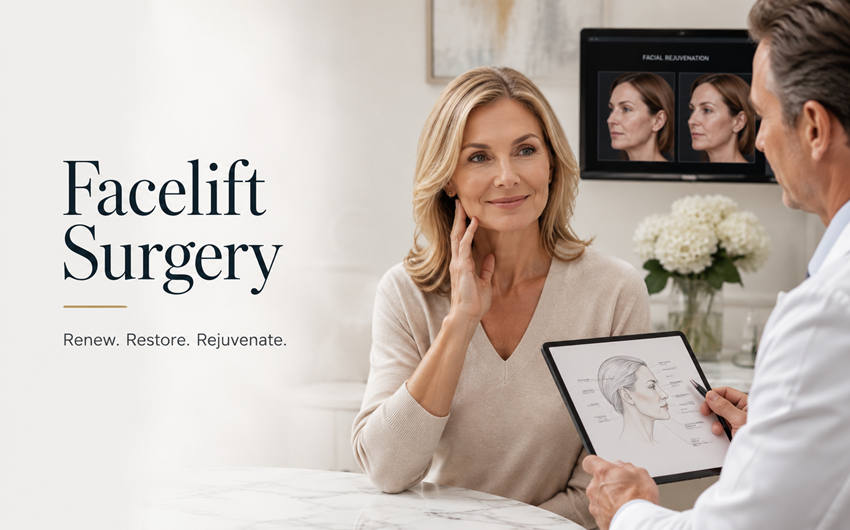
Top Questions to Ask During Your Facelift Surgery Consultation in Toronto

Most people walk into a consultation underprepared. That’s not a criticism — it’s just what tends to happen when someone is nervous, unfamiliar with medical environments, and relying on the surgeon to lead the conversation. The problem is that approach leaves a lot of useful information uncollected.
Good consultations are two-way. The surgeon assesses the patient. The patient assesses the surgeon. Both sides of that equation matter.
Here are the questions worth bringing in.
Are you board-certified in plastic surgery, and through which body?
In Canada, the relevant standard is certification through the Royal College of Physicians and Surgeons. That’s not the only credential worth asking about, but it’s the baseline. Fellowship training and professional affiliations add more context.
Don’t assume. Ask directly.
How many facelifts do you perform in a year?
This matters more than people think. A surgeon can be fully qualified and still not be the right fit for a specific procedure. Volume tells you something. A surgeon for whom facelift surgery is a core part of their practice has a different level of familiarity with its nuances than one who performs it occasionally.
This is worth thinking about carefully when looking at facelift surgery Toronto options specifically. The city has a real concentration of cosmetic practices. That means there are genuine choices available. There’s no reason to settle for someone who does this work infrequently when experienced specialists are within reach.
What technique are you recommending for me, and why?
There isn’t one standard facelift. SMAS techniques, deep plane approaches, mini facelifts — these aren’t interchangeable. Each suits different patients, different degrees of facial aging, different areas of concern.
If a surgeon gives a vague answer here, push back. The recommendation should connect directly to something specific about your face — where the laxity is, what your skin quality is like, what you’re actually trying to correct. A surgeon who understands your case should be able to explain their thinking without much prompting.
Can you show me before and after photos of patients who looked like me before surgery?
Most clinics have galleries. The more important question is whether those galleries include cases that actually resemble yours. Similar age. Similar skin. Similar concerns. A portfolio of ideal candidates with optimal results doesn’t say much about what to expect in your specific situation.
Ask for cases with similar starting points. If possible, ask whether any previous patients have agreed to speak about their experience. Firsthand accounts carry more weight than polished photos.
What does recovery look like week by week?
This is the question that gets skipped most often and regretted most reliably. People focus on the procedure and underplan everything that comes after it.
Bruising and swelling peak early and resolve gradually. Most patients manage light activity within two to three weeks. More physical exertion takes longer. Final results can take months to fully settle — the face continues to change as swelling clears and tissues relax. Ask about driving. Ask about alcohol and medications. Ask about sun exposure. Ask exactly when exercise becomes safe again. Ask how reachable the clinic is during recovery if something feels wrong.
Vague answers to these questions are a red flag.
What are the realistic risks for someone with my health history?
Every consent form lists generic risks. That’s not what this question is about. What you’re after is a personalized conversation — one that accounts for your specific medical background, any medications you’re taking, and any factors that might affect either the surgery or the healing process afterward.
A surgeon who handles this question openly and specifically is one who takes it seriously. Reluctance to engage with it directly is worth paying attention to.
What will this procedure actually change — and what won’t it?
Facelift surgery addresses specific things. Jowling. Neck laxity. Mid-face descent. It doesn’t change skin texture in any significant way, won’t eliminate fine lines across the board, and won’t address concerns that fall outside its scope.
That’s not a limitation worth hiding. It’s information that helps patients set accurate expectations. Surgeons who are upfront about boundaries tend to produce more satisfied patients — not because the results are better, but because the results match what was actually discussed.
Closing Thought
None of these questions are confrontational. They’re practical. A surgeon worth choosing will answer them directly and without hesitation. One who hedges, oversimplifies, or steers away from specifics is telling you something useful too — just not the kind of useful you’re looking for.
Leave the consultation with real answers. The decision that follows will be better for it.