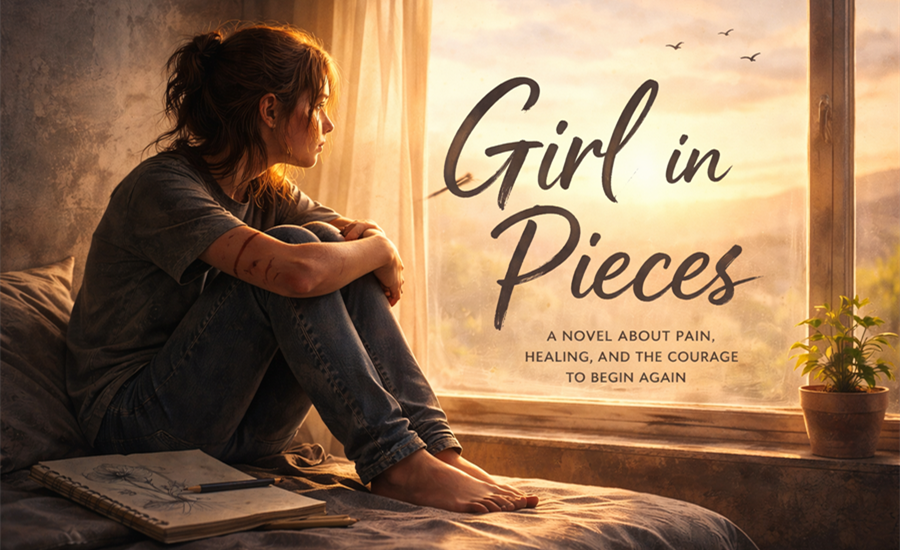
Girl in Pieces Summary and Reflection on Pain, Healing, and Fragile Redemption

A long-unseen friend once brought me news so sorrowful that even now I can feel the hush that fell over the conversation. Her child had begun hurting herself. My friend was not dramatic, not careless, not prone to panic, and that may be why her grief felt so devastating. She was not simply frightened. She was bewildered. She kept circling the same invisible wall: Why would a child do this to her own body? What hurt had gone so deep that it had taken this form? I had no neat answer for her. I do not think neat answers belong anywhere near that kind of pain.
Not long after, I read Girl in Pieces by Kathleen Glasgow. I opened it with caution, but also with a kind of moral attention, because the sorrow my friend had described was no longer abstract to me. It had a mother’s face. It had the tremor of confusion inside it. And as I read, I felt that the novel was doing something rare. It was not excusing pain, romanticizing pain, or turning self-destruction into a dramatic pose. It was entering the broken interior of a wounded girl and asking us to stay there long enough to understand how healing begins—not as a miracle, but as a series of small, trembling choices.
Girl in Pieces summary
Girl in Pieces follows Charlotte “Charlie” Davis, a seventeen-year-old girl who has already endured more suffering than many people face in decades. When the novel opens, Charlie is in a treatment facility after a severe act of self-harm. She is physically bandaged and emotionally shut down, almost unable to speak. That silence matters. Charlie is not merely quiet. She is a girl who has retreated so far into pain that words themselves seem unsafe.
As the novel unfolds, we begin to understand the history that has shattered her. Charlie’s father died by suicide. Her mother, consumed by her own bitterness and depletion, became harsh and neglectful. Poverty marked Charlie early, isolating her from other girls before she found friendship with Ellis, whose presence briefly gave her life warmth, mischief, and belonging. But even that friendship becomes part of Charlie’s grief. Ellis spirals into her own anguish, and Charlie carries a terrible burden of regret connected to what happened to her.
The book also reveals Charlie’s periods of homelessness, her exposure to danger, exploitation, hunger, and the constant humiliation of trying to survive while still young enough to need protecting. Glasgow does not soften these chapters, and that honesty is part of what makes the novel so difficult and so valuable. Charlie is not “troubled” in the vague, convenient way adults sometimes label suffering teenagers. She is traumatized. She has been abandoned by too many of the structures that should have held her.
Eventually Charlie leaves treatment and goes to Tucson, where she tries to begin again. The hope here is tentative, almost embarrassed by itself. She gets a job at a coffee shop called True Grit. She finds people who are, if not perfect, at least capable of moments of kindness. She rediscovers drawing, and art begins to offer her something language often cannot: a way to move pain outside the body without denying it. In Tucson, Charlie also reconnects with Mikey, a boy she once loved, though that connection does not become the rescue fantasy she may have imagined.
Instead, Charlie becomes entangled with Riley, a charismatic musician whose tenderness and damage are knotted together. Their relationship is one of the most heartbreaking parts of the novel because it shows how easily wounded people can mistake recognition for safety. Riley sees Charlie’s brokenness because he is broken too. But being seen is not the same as being protected, and shared damage is not the same as love. Charlie wants to save him. She wants, perhaps, to prove that if she can keep someone else from falling apart, then her own pain might be redeemed. But Riley is sinking into addiction, and Charlie is not strong enough yet to love anyone without also disappearing inside them.
The novel continues through setbacks, relapses, grief, and emotional aftershocks. Blue, a girl Charlie knew in treatment, re-enters her life and becomes an important figure in the story’s movement toward solidarity and survival. Other losses strike with cruel force. Charlie unravels again. Yet the book never quite loses sight of a narrow thread of hope. In the final stretch, Charlie is taken into the orbit of Felix, an artist whose presence opens a different possibility for her life. By the end, recovery is not presented as complete or clean. Charlie is not “fixed.” But she is moving. She is choosing a future. She is beginning, however shakily, to believe she may belong to herself.
What the novel understands about self-harm
What moved me most, especially after hearing my friend’s anguish, was the novel’s refusal to treat self-harm as a simple cry for attention or a puzzle that can be quickly decoded. Girl in Pieces understands that self-harm can emerge where language has failed, where grief has become unspeakable, where shame has curdled inward, where pain feels too large and too invisible all at once. The body becomes both battleground and message board. It says: something is wrong, something is unbearable, something has happened that cannot stay hidden any longer.
That does not make the act beautiful. Glasgow is too honest for that. But she is compassionate enough to show why condemnation is useless. A child who harms herself is not asking for scolding. She is revealing, in the most alarming way possible, that ordinary speech has broken down. That was the truth I kept returning to as I thought about my friend. Her sorrow was real, but so was her confusion. This novel gave shape to that confusion. It reminded me that the question is not simply, “Why would someone do this?” The deeper question is, “What pain has made this feel necessary?”
Why the book feels so emotionally true
Many novels about trauma are earnest but orderly. They move cleanly from wound to insight, from darkness to light, and the reader can feel the author arranging the furniture of suffering into something aesthetically pleasing. Girl in Pieces is more disorienting than that, and therefore more convincing. Charlie does not heal in a straight line. She reaches for hope and then distrusts it. She longs for love and then drifts toward what harms her. She wants to disappear and to be found in the same breath. This contradiction is not a flaw in the novel. It is one of its most painful truths.
Glasgow also writes with a raw lyrical pulse that suits Charlie’s inner life. The prose often feels fractured in the right way, as if thought itself has been splintered by sorrow. And yet amid the brokenness, there are moments of startling beauty—brief flashes in which music, drawing, desert light, memory, or human tenderness seem to gather Charlie back into the world for a moment longer. That balance is hard to achieve. Too much beauty and the pain becomes stylized. Too much brutality and the reader goes numb. This novel walks the narrow line between them.
The role of art, friendship, and witness
One of the quiet mercies of the book is that healing does not arrive as a speech, a diagnosis, or a perfect romance. It arrives through smaller, humbler things. A place to work. Someone who notices. A room that feels temporarily safe. A pencil in the hand. Art matters deeply in this novel because it gives Charlie another form of speech. When she cannot explain herself in the language adults demand, she can still draw. She can still make marks. She can still transform what is inside her into something visible.
Friendship matters too, though the novel is honest about how uneven friendship can be among the wounded. Some people fail Charlie. Some use her. Some love her badly. But some remain. Some return. Some stand beside her long enough for survival to seem imaginable. That, perhaps, is one of the novel’s most tender convictions: healing is not a solitary triumph of willpower. It often begins when someone bears witness to your brokenness without turning away in disgust.
That is why the novel stayed with me after I finished it. It is not only about trauma. It is about witness. It is about what happens when pain is finally seen without being simplified.
Why Girl in Pieces deeply moved me
I think the book moved me because it reached two kinds of grief at once. On one level, it brought me close to Charlie, to the interior life of a girl whose suffering had become almost unbearable. On another level, it returned me to my friend—to the stunned love of a parent standing outside a locked room of pain, desperate to understand how her child had arrived there. The novel does not hand that parent a key. But it does open a window.
It says, in effect, that the hurting child is not incomprehensible. She is not monstrous, manipulative, or beyond reach. She is carrying something heavy enough to distort her relationship to her own body, her own future, her own worth. That recognition does not erase fear. But it does make compassion possible, and compassion is often where real help begins.
I was also moved by the novel’s idea of redemption. Not grand redemption. Not cinematic redemption. Nothing in Girl in Pieces suggests that one good day cancels years of damage. Its vision is more modest and more believable than that. Redemption here means that a life can remain wounded and still move toward meaning. It means that relapse does not erase desire for healing. It means that the self, though fractured, is not beyond gathering.
There is something deeply human in that vision. Many people live in pieces, even if their pain never takes a visible form. Many carry childhood grief, humiliation, abandonment, addiction, loneliness, or shame that never fully leaves them. What this novel offers is not the fantasy of becoming untouched. It offers the harder, kinder hope that even a shattered life can still become livable, and maybe even beautiful in a new, scarred way.
Final reflection
If someone asks for a straightforward Girl in Pieces summary, the simplest answer is that it is the story of a girl named Charlie Davis trying to survive the aftermath of trauma and slowly learning that healing is possible, though never easy. But that summary is too small for what the book actually does. This is not just a novel about self-harm. It is a novel about what despair does to the soul, what tenderness can and cannot repair, and how redemption sometimes begins in the faintest decision to stay alive one more day.
For me, the book will always be tied to my friend’s grief-stricken voice. Because of that, I did not read it as distant literature. I read it as a human document, a fragile lantern lowered into a dark place many families do not know how to speak about. And perhaps that is why it lingers. Girl in Pieces does not pretend that pain can be solved by insight alone. It only insists, with fierce and trembling honesty, that even from the edge, a person may still turn toward life.