From Gaming to AI: Harnessing the Power of an RTX 4090 Workstation

Transitioning from high-frame-rate gaming to professional AI development requires a shift in how hardware performance is utilized. High-end RTX 4090 desktops serve as versatile platforms capable of handling ray-traced graphics and complex mathematical computations simultaneously. The hardware once reserved for enthusiasts has become a primary tool for researchers and data scientists who require local compute power. Using one machine for both gaming and professional AI workloads maximizes investment value and offers a flexible environment for experimentation.
Technical specifications for machine learning
The Ada Lovelace architecture provides specific advantages for deep learning and neural network training. High memory capacity allows for larger batch sizes during training, which reduces the time needed for model convergence. Large-scale models that previously required enterprise-grade hardware can now run on consumer-level workstations. Key technical features include:
- 24 GB GDDR6X memory for handling complex datasets and high-resolution textures.
- Fourth-generation Tensor cores for accelerated matrix multiplication.
- 16,384 CUDA cores to manage parallel processing tasks.
- 384-bit memory bus for high-speed data transfer between the GPU and VRAM.
These specifications allow the card to function as a bridge between consumer hardware and professional-grade accelerators. The high core count is particularly beneficial for tasks involving heavy floating-point arithmetic, which is the backbone of modern artificial intelligence.
Practical applications in artificial intelligence
Local execution of AI models offers privacy and speed advantages compared to cloud-based API services. Developers can test code and iterate on models without recurring subscription costs or data latency issues. A local workstation provides full control over the software stack and keeps sensitive data on-site. The RTX 4090 excels in several specific domains:
- Training and fine-tuning language models with up to 70B parameters (via quantization).
- Running Stable Diffusion and Flux for high-resolution image synthesis.
- Hardware-accelerated video upscaling and frame interpolation.
- 3D rendering and real-time path tracing in professional creative suites.
Executing these tasks locally removes the reliance on external servers and internet stability. It allows for a more iterative workflow where changes can be implemented and tested within seconds rather than minutes.
Thermal management and power requirements
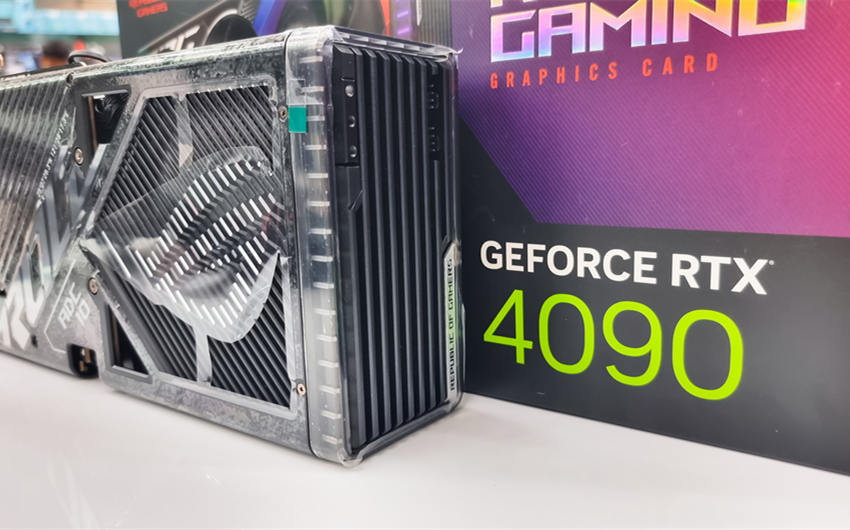
Managing the 450W TGP (Total Graphics Power) requires a specific approach to system cooling and power delivery. A standard desktop case often lacks the space or airflow capacity for such a massive component. Hyper Cyber builds systems with high-efficiency power supplies and multi-fan configurations to prevent thermal throttling during long training sessions. When a GPU reaches high temperatures, it lowers its clock speed, which directly impacts the speed of AI computations. Choosing a pre-configured build helps avoid common compatibility issues:
- High-wattage power supplies with native 12VHPWR or 12V-2×6 connectors to ensure stable power delivery.
- Extended chassis designs to accommodate triple-fan cooling solutions.
- Vertical or reinforced mounting to prevent structural damage from GPU weight.
- Liquid cooling options for the CPU to reduce ambient heat inside the case.
Proper integration of these components maintains system stability under 100% load for extended periods. A stable environment is a fundamental requirement for researchers who leave their machines running overnight to process large datasets.